Estimating concrete ditch lining begins with a practical question: what is the cost of concrete ditch lining per meter? The answer rarely fits one universal price. A 1-meter channel beside a rural road differs greatly from a reinforced drain crossing an urban construction site.
Industry cost references support this caution. RSMeans construction cost data separates materials, labor, equipment, productivity, and location adjustments. Turner & Townsend’s International Construction Market Survey also shows that regional labor markets and supply-chain conditions can significantly influence civil construction prices. These reports do not provide one fixed ditch-lining rate. They provide a stronger method for building a defensible estimate.
Small details matter.
A 100-millimeter unreinforced lining may require less concrete, steel, and formwork than a 150-millimeter reinforced section. Excavation, subgrade preparation, joints, curing, access restrictions, pumping, and traffic control can change the final cost. FHWA hydraulic design guidance emphasizes that channel geometry, hydraulic performance, erosion exposure, and site conditions should guide lining selection. The cheapest surface is not always the most durable choice.
This guide compares ten common cost questions and answers them with practical estimating logic. It considers concrete volume per meter, reinforcement, labor productivity, transport distance, project scale, and regional pricing. It also explains why contractor quotations may differ from published rates.
Some estimates remain uncertain.
That is normal. Field measurements can be incomplete, and productivity assumptions may prove optimistic. A reliable budget should show its assumptions clearly, allow contingency, and be checked against current supplier quotations and local construction data.
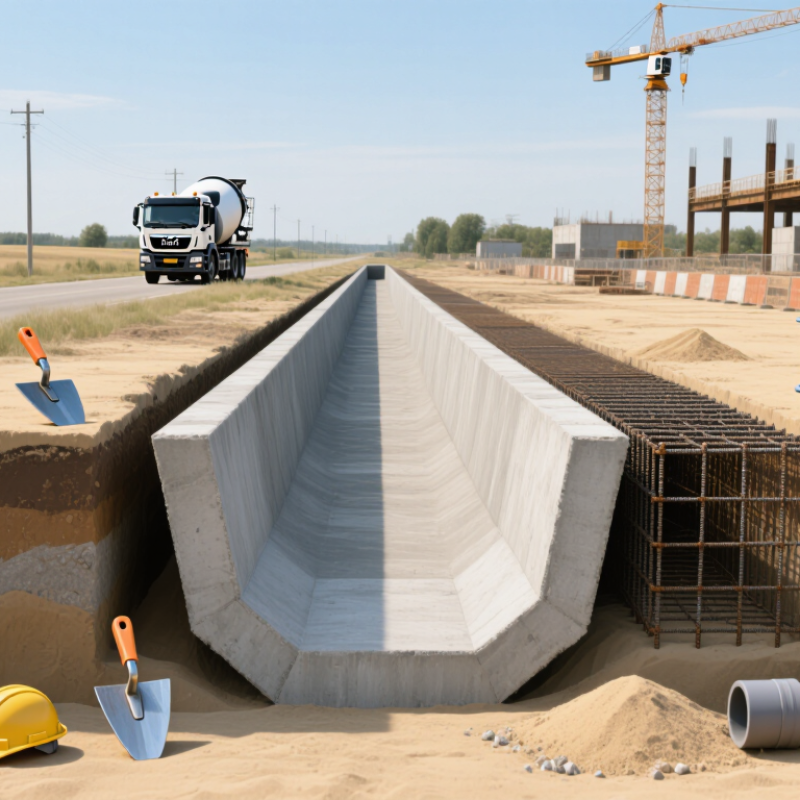
Define the Scope: 100–300 mm Lining Thickness and C25/30 Concrete
Top 10 Concrete Ditch Lining Cost per Meter Answers?
A reliable cost estimate starts with the lining scope. Specify a thickness between 100 and 300 mm, then confirm the ditch width, side slopes, and total length. C25/30 concrete is a common structural choice, but strength alone does not define performance. Subgrade preparation matters. So does drainage beneath the lining.
For one linear meter, concrete volume depends on the lined cross-section. A 1.2-meter-wide ditch with 150 mm thickness needs about 0.18 cubic meters before side slopes and construction waste. The cost per meter may include excavation, trimming, formwork, reinforcement, concrete delivery, placement, joints, curing, and traffic control. Access can change the price sharply. Small pours often cost more.
On site, I check the base with a straightedge and remove soft pockets before placing concrete. The lining should have controlled joints, a consistent fall, and enough curing protection. A 100 mm lining may suit light flow and stable ground, but it can crack under heavy loading. A 300 mm lining offers greater robustness, yet it may waste material where erosion risk is low. I have seen estimates fail because they priced concrete only. That mistake is easy to repeat. Measurements also need review after excavation, because actual ditch geometry rarely matches the drawing perfectly. A clear schedule should show thickness zones, concrete volume, reinforcement requirements, and exclusions before contractors submit meter rates.
Top 10 Concrete Ditch Lining Cost per Meter Answers
Indicative installed cost for a 1 m wide concrete-lined ditch using C25/30 concrete, with lining thicknesses from 100 to 300 mm. Values are planning benchmarks in USD per linear meter, excluding land acquisition, major drainage structures, taxes, and unusual ground conditions.
The estimate assumes 1 m² of lined surface per linear meter, normal site access, basic surface preparation, ordinary construction joints, and standard curing. Increasing thickness mainly raises concrete volume, while labor, plant, preparation, and joint costs remain comparatively stable.
Measure Quantities: One Meter Equals Lining Area × Thickness in m³
Top 10 Concrete Ditch Lining Cost per Meter Answers?
Estimating one meter of concrete ditch lining starts with quantity, not price. One linear meter equals the lining area multiplied by thickness, producing volume in m³. For example, a ditch with 2.8 m² of lined surface and a 100 mm thickness needs 0.28 m³ of concrete per meter. One meter is not one cubic meter.
Measure the bed and both side slopes along their actual finished surfaces. Do not use the ditch width alone. Add concrete volume for each surface, then allow for practical waste only after checking the specification. Cost per meter may include concrete, placement, formwork, reinforcement, joints, curing, access, and labor. In my estimating work, small geometry errors often affect the final price more than expected. I still recheck field dimensions against drawings, because drawings can simplify irregular ground.
Tips:
Write every measurement in meters. Convert 100 mm to 0.10 m before calculating. Keep a simple worksheet showing area, thickness, volume, and unit rates. Ask contractors for separate prices for concrete and installation. Local transport can change the result sharply. A neat calculation may still be incomplete. Check outlets, corners, and construction joints before accepting the final cost per meter.
Build the Rate: Concrete, 40–120 kg/m³ Reinforcement, and Formwork
A reliable ditch-lining rate starts with geometry, not a guessed price per meter. Measure the channel width, wall height, slab thickness, slopes, access, and excavation limits. For a 1 m channel length, concrete volume equals the lining cross-section multiplied by one meter. Normal-weight concrete is commonly estimated near 2,400 kg/m³ under EN 206 guidance. Thus, a 0.12 m³ lining needs about 0.29 tonnes of fresh concrete.
Reinforcement can change the rate sharply. At 40–120 kg/m³, a 0.12 m³ section requires roughly 4.8–14.4 kg of steel per meter. Include cutting, laps, chairs, tying wire, and waste. The American Concrete Institute’s ACI 211.1 guidance supports mix proportioning by exposure and strength, but it does not replace local durability design. That matters near standing water. Small details matter.
Formwork is often underestimated. Price both contact area and repeated use, including braces, release treatment, stripping, and cleaning. The Federal Highway Administration’s HEC-15 guidance identifies finished concrete as a low-roughness channel lining, with hydraulic performance affected by surface quality and joints. Cost databases such as RSMeans 2024 show that labor and regional access can shift installed rates substantially. I would therefore build the meter rate as concrete, reinforcement, formwork, placing, curing, joints, testing, and site overhead. A neat spreadsheet can still be wrong if truck access or dewatering is ignored. Allow a measured contingency, then challenge it.
Top 10 Concrete Ditch Lining Cost per Meter Answers? - Build the Rate: Concrete, 40–120 kg/m³ Reinforcement, and Formwork
| No. |
Typical Ditch Profile |
Clear Width / Depth
(m) |
Lining Thickness
(mm) |
Concrete
(m³/m) |
Reinforcement
(kg/m³) |
Steel
(kg/m) |
Formwork
(m²/m) |
Concrete
Cost (USD/m) |
Rebar
Cost (USD/m) |
Formwork
Cost (USD/m) |
Placement &
Preliminaries (USD/m) |
Estimated Total
(USD/m) |
| 1 |
Small trapezoidal agricultural drain |
0.45 / 0.30 |
75 |
0.060 |
40 |
2.4 |
0.80 |
11 |
5 |
38 |
24 |
78 |
| 2 |
Residential stormwater ditch |
0.60 / 0.35 |
80 |
0.080 |
50 |
4.0 |
1.00 |
15 |
9 |
48 |
30 |
102 |
| 3 |
Standard trapezoidal roadside ditch |
0.75 / 0.40 |
80 |
0.100 |
60 |
6.0 |
1.20 |
19 |
13 |
58 |
36 |
126 |
| 4 |
Urban drainage channel |
0.90 / 0.45 |
90 |
0.120 |
70 |
8.4 |
1.40 |
22 |
18 |
67 |
42 |
149 |
| 5 |
Medium-capacity farm drainage channel |
1.05 / 0.50 |
90 |
0.140 |
80 |
11.2 |
1.60 |
26 |
25 |
77 |
48 |
176 |
| 6 |
Roadside ditch with traffic loading |
1.20 / 0.55 |
100 |
0.160 |
90 |
14.4 |
1.80 |
30 |
32 |
86 |
55 |
203 |
| 7 |
Deep trapezoidal stormwater drain |
1.35 / 0.65 |
100 |
0.180 |
100 |
18.0 |
2.00 |
33 |
40 |
96 |
64 |
233 |
| 8 |
Large municipal open channel |
1.60 / 0.75 |
110 |
0.210 |
110 |
23.1 |
2.30 |
39 |
51 |
110 |
75 |
275 |
| 9 |
High-flow flood relief channel |
1.90 / 0.90 |
120 |
0.240 |
120 |
28.8 |
2.60 |
44 |
63 |
125 |
88 |
320 |
| 10 |
Heavy-duty reinforced drainage channel |
2.20 / 1.05 |
125 |
0.280 |
120 |
33.6 |
3.00 |
52 |
74 |
144 |
105 |
375 |
|
Rate basis: Indicative 2026 budget rates in USD per linear metre. Concrete allowance uses an installed rate of approximately USD 185/m³, reinforcement uses approximately USD 2.20/kg, and formwork uses approximately USD 48/m². Placement and preliminaries include minor excavation trimming, blinding or base preparation, concrete placing, vibration, curing, and normal site handling. Rates exclude major excavation, dewatering, drainage outlets, joints beyond normal construction joints, taxes, design fees, and exceptional ground conditions.
|
Compare Cost Bands: $80–$180/m³ Concrete and $25–$90/m² Installation
Concrete ditch lining costs are easier to compare when material and installation remain separate. Planning rates often place concrete at $80–$180 per cubic meter. Installation may add $25–$90 per square meter. These figures are not interchangeable. A linear-meter price depends on ditch width, depth, slopes, and lining thickness. For a linear-meter estimate, multiply the lined surface area within one meter by the applicable rates.
Measure the actual lining area before calculating volume. A 100-millimeter layer requires 0.10 m³ for every square meter. Concrete alone would therefore cost about $8–$18 per m². Installation could raise the combined figure to $33–$108 per m². Excavation, reinforcement, joints, curing, drainage preparation, and access may cost extra. Wet subgrade is a warning sign. Difficult ground can push labor beyond the upper band.
Experienced site teams also check delivery distance, pump access, temperature, and hand-finishing requirements.
I have seen estimates fail when narrow ditches demanded more labor than their concrete volume suggested.
My early calculations underweighted edge forming and curing protection. That mistake was expensive.
A reliable quote should show quantities, thickness, waste allowance, and separate unit rates. Recheck every assumption against a site survey. A neat spreadsheet cannot reveal soft shoulders or unexpected groundwater.
Rank Ten Cost Drivers: Access, Width, Labor, Drainage, and 10–20% Contingency
Top 10 Concrete Ditch Lining Cost per Meter Answers?
A practical allowance for concrete ditch lining is often $90–$280 per meter. This range is only a planning guide. Field measurements can change it quickly. Ranked cost drivers are: 1) restricted access, 2) ditch width and depth, 3) labor productivity, 4) excavation and subgrade preparation, 5) concrete volume and strength, 6) reinforcement and joint spacing, 7) drainage outlets, 8) formwork and curing, 9) haul distance and spoil disposal, and 10) permits, testing, and traffic control. The U.S. Bureau of Labor Statistics reports continuing price movement in construction inputs, while transportation cost guidance from the Federal Highway Administration shows why short haul routes can still affect unit rates. A narrow ditch may cost more per meter when workers cannot use equipment safely.
Drainage deserves special attention. Water behind the lining can cause uplift, cracking, or winter damage. Add filter material, weep outlets, or a perforated drain where soil conditions require them. Labor is often underestimated. A crew placing concrete by hand may complete far fewer meters daily than a crew using accessible mechanical equipment. My rough estimating error can reach 20% when drawings omit groundwater or disposal details. That is uncomfortable, but realistic.
Tips: Measure ten-meter trial sections. Record crew hours, concrete tickets, weather, and rejected work. Request separate prices for access, drainage, and restoration. Carry a 10–20% contingency, with the higher allowance used for unknown ground conditions.
Conclusion
Estimating the cost of concrete ditch lining per meter starts with a clear project scope. A typical design may use C25/30 concrete with a lining thickness of 100–300 mm. For each meter of ditch, calculate the required concrete volume by multiplying the lining area by its thickness, then include reinforcement, formwork, excavation, preparation, placement, and curing. Reinforcement may range from 40–120 kg per cubic meter, depending on loading and ground conditions.
So, what is the cost of concrete ditch lining per meter? A practical estimate can be developed from concrete rates of approximately $80–$180 per cubic meter and installation costs of about $25–$90 per square meter. The final figure depends on ten major factors, including site access, ditch width and depth, labor productivity, drainage requirements, excavation conditions, reinforcement, formwork complexity, transport, weather, and project scale. Adding a 10–20% contingency helps cover design changes, material waste, and unexpected site difficulties.

 MRECH Machinery